 FrametimeDesk
Why not use the game's own numbers
Because a game cannot measure the parts of the chain that matter most. In-engine latency reporting begins when the engine receives the input event and ends when it submits a frame, which excludes the polling interval, the driver, the compositor and the display's own processing. Those excluded stages are frequently larger than the ones being measured.
So we measure with a camera. A modified controller closes a circuit and illuminates a small indicator in the same frame as the input; a camera recording at 1,000 frames per second captures both the indicator and the screen. The latency is the number of camera frames between the two, which includes every stage a player actually experiences.
Setup
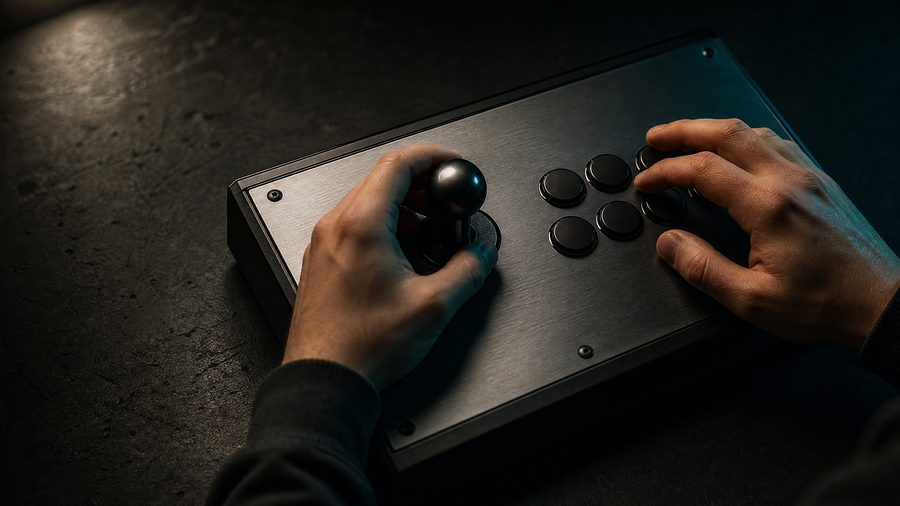
All six titles were tested on the same bench, on the same display, at the same refresh rate, in training mode, with a single character performing a single fast attack from neutral. Three input devices were used: a wired arcade stick, a wired gamepad and a wireless gamepad on its own dongle. Eight hundred samples per device per title, 14,400 in total.
Every figure below is a median of 800 samples with the interquartile range attached, because a latency figure without a spread tells you nothing about consistency, and consistency is what a player actually adapts to.
Results
| Title | Arcade stick | Wired pad | Wireless pad | IQR |
|---|---|---|---|---|
| Iron Verse | 38 ms | 41 ms | 49 ms | ±4 ms |
| Ninth Round | 44 ms | 46 ms | 55 ms | ±5 ms |
| Grave Tempo | 51 ms | 54 ms | 61 ms | ±6 ms |
| Halcyon Clash | 58 ms | 60 ms | 68 ms | ±5 ms |
| Sundown Fists | 66 ms | 69 ms | 77 ms | ±9 ms |
| Paper Lantern Duel | 79 ms | 81 ms | 90 ms | ±11 ms |
Two things stand out. The first is the range: 38 to 79 milliseconds on identical hardware with an identical input device is an enormous engineering difference, and it is invisible in every review of these games including, until now, ours.
The second is the interquartile range in the two slowest titles. Paper Lantern Duel is not merely slow, it is inconsistent, and an ±11 millisecond spread means the same input arrives a frame earlier or later depending on nothing the player can perceive or control. That is worse for competitive play than a higher but stable figure.
The wireless penalty
Consistently between 8 and 11 milliseconds across all six titles, which is smaller than the folklore suggests and larger than the marketing does. It is roughly half a frame at sixty hertz. For most players it is irrelevant; for the two titles already above 66 milliseconds it pushes the total into territory where reactive defence stops being reliable.
What this does not tell you
- Nothing about netcode. These are local measurements. Online behaviour is a separate problem with separate methods, and we will not conflate the two.
- Nothing about your display. Our fixed panel contributes a constant to every figure. The differences between titles are valid; the absolute numbers will shift on your hardware.
- Nothing about whether the games are good. Grave Tempo is the most interesting fighting game in this group and it is third on this table.
The one recommendation
If you play any of these competitively, the arcade stick figures are the ones to read, wireless costs you half a frame in every case, and Paper Lantern Duel's inconsistency is a genuine reason to prefer a different title regardless of how much you like it. Everything else here is information rather than advice.